

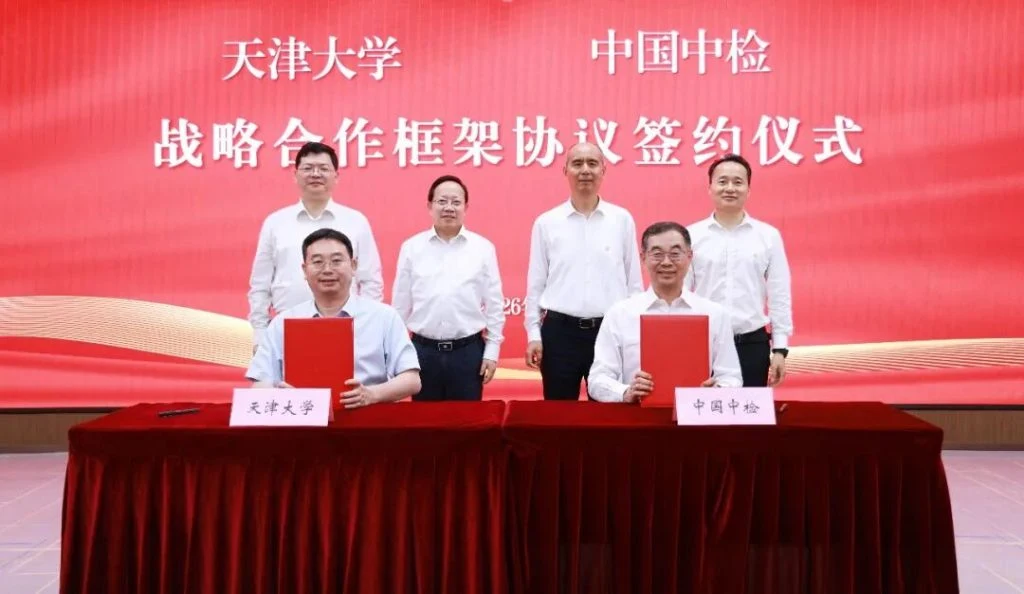
CCIC and Tianjin University Sign Strategic Cooperation Framework Agreement

     On July 1, China Certification & Inspection Group (CCIC) and Tianjin University signed a strategic cooperation framework agreement in Beijing.Chai Liyuan, President and Deputy Party Secretary of Tianjin University; Xu Zengde, Party Secretary and Chairman of CCIC; and Nie Weixun, Deputy Party Secretary and District Mayor of Nankai District, Tianjin, witnessed the signing and held exchange talks. Wang Tianyou, Member of the Party Committee and Executive Vice President of Tianjin University, and Li Yongji, Deputy Party Secretary and General Manager of CCIC, signed the agreement on behalf of the two sides. Wan Xinming, Member of the Party Committee and Deputy General Manager of CCIC, attended the signing ceremony.
Remarks by Chai Liyuan
   Chai Liyuan stated that Tianjin University is currently focusing on major national strategic needs. It is advancing reforms in teaching and research, boosting basic research and key technological development, and actively building platforms for industry-education integration.
 

     Deepening strategic cooperation with leading central enterprises is a key move to serve national development priorities and drive industrial upgrading.As a national leader in quality services, a source of major quality technology breakthroughs, and a core force advancing the national quality strategy, CCIC plays a vital role in developing national quality infrastructure and supporting high-quality industrial growth. Its core businesses align closely with Tianjin University’s academic disciplines, creating huge room for joint work.

     Chai hoped the signing would mark a new starting point. The two sides will jointly build platforms, carry out joint research projects, share research outputs and cultivate talent together. They will build an integrated innovation ecosystem covering education, science and talent development across eight key sectors including energy, advanced materials, information technology and healthcare. The partnership will better connect university innovation resources with industrial strengths, fuel high-end manufacturing upgrades and support greater sci-tech self-reliance at higher levels.

Remarks by Xu Zengde
    Xu Zengde opened by saying the signing fell on the 105th anniversary of the founding of the Communist Party of China, making the partnership a special tribute to the Party’s birthday. He thanked Tianjin University for its long-term strong support to CCIC.Tianjin University, China’s first modern university, has long upheld the mission of “strengthening the nation through education” and the motto of “seeking truth from facts”. It has supplied top talent for China’s industrial system, the Two Bombs, One Satellite project and major national engineering tasks, standing as a key pillar of national strategic science and technology and the national spirit.
 
    This agreement puts into practice President Xi Jinping’s important guidance on integrating education, science and talent development. It will deepen links between technological and industrial innovation, boost central-local coordination, and build an integrated industry-university-research-application innovation ecosystem.
 
     Xu called for deeper university-enterprise collaboration. The two sides will conduct basic research and technical breakthroughs for emerging strategic industries such as new energy, new energy vehicles and low-altitude economy, as well as green and low-carbon development. They will build joint research platforms for intelligent connected systems, precision testing, smart labs and low-altitude economy. The partners will also cooperate to train high-level applied talent for inspection and testing, speed up the commercialization of research results, power industrial upgrading in Tianjin and advance coordinated development of the Beijing-Tianjin-Hebei region.

     The two parties will deepen cooperation in three core areas: building research platforms for energy and power technology, carrying out joint scientific and technological research, and strengthening talent training. They will accelerate the industrial rollout of cutting-edge technologies, form a long-term mechanism for deep industry-university-research-application integration, and drive high-quality regional economic growth.

Leave a Reply

Your email address will not be published. Required fields are marked *